RETURN TO TK and GMAN WEBSITE

Saturday, June 17, 2017

Ballard, Washington

Leaving Pike Place Market we headed to the neighborhood of Ballard. Ballard is located in the northwestern part of Seattle. To the north it is bounded by Crown Hill, (N.W. 85th Street); to the east by Greenwood, Phinney Ridge and Fremont (along 8th Avenue N.W.); to the south by the Lake Washington Ship Canal; and to the west by Puget Sound’s Shilshole Bay. The neighborhood’s landmarks include the Hiram M. Chittenden Locks (known locally as the "Ballard Locks"), the Nordic Heritage Museum, the Shilshole Bay Marina, and Golden Gardens Park.
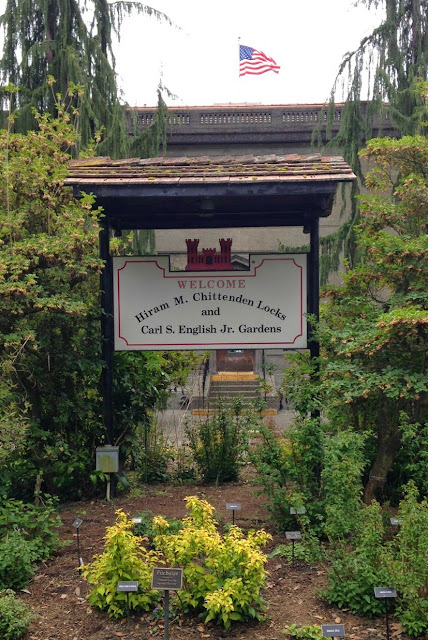
Entrance to Carl S. English Jr. Botanical Gardens and Hiram M. Chittenden Locks

The Hiram M. Chittenden Locks, or Ballard Locks, is a complex of locks at the west end of Salmon Bay, in Seattle, Washington's Lake Washington Ship Canal, between the neighborhoods of Ballard to the north and Magnolia to the south.

We wanted to know and followed the fish but didn't realize it was across the locks until we were on our way back to the parking lot


Beautiful botanical gardens
The Ballard Locks carry more boat traffic than any other lock in the US, and the Locks, along with the fish ladder and the surrounding Carl S. English Jr. Botanical Gardens attract more than one million visitors annually, making it one of Seattle's top tourist attractions. 


What's the name of this flower??? 

The construction of the locks profoundly reshaped the topography of Seattle and the surrounding area, lowering the water level of Lake
Boat approaching from Salmon Bay
Washington and Lake Union by 8.8 feet (2.7 m), adding miles of new waterfront land, reversing the flow of rivers, and leaving piers in the eastern half of Salmon Bay high and dry.
  The Locks are listed on the National Register of Historic Places and the American Society of Civil Engineers Historic Civil Engineering Landmarks.

Boat from Salmon Bay going through locks to Shilshole Bay


Exit from locks to Shilshole Bay

Seattle, Washington

Our next big adventure landed us in the beautiful state of Washington with our first stop being Seattle. 


View of downtown Seattle from Center for Wooden Boats

Seattle, a city on Puget Sound in the Pacific Northwest, is surrounded by water, mountains and evergreen forests, and contains thousands of acres of parkland. Washington State’s largest city, it’s home to a large tech industry, with Microsoft and Amazon headquartered in its metropolitan area. The futuristic Space Needle, a 1962 World’s Fair legacy, is its most iconic landmark.


Best view of Seattle from Kerry Park

Kerry Park is a 1.26-acre park on the south slope of Queen Anne Hill in Seattle, located at the corner of Second Avenue West and West Highland Drive.  The park offers the best view of the city. According to a plaque on a wall in the park, "Kerry Park was given to the City in 1927 by Mr. and Mrs. Albert Sperry Kerry, Sr., so that all who stop here may enjoy this view." That view encompasses downtown SeattleElliott Bay, the West Seattle peninsula, Bainbridge Island, and Mount Rainier.


Mount Rainier


Pike Place Market is a public market overlooking the Elliott Bay waterfront in Seattle. The Market opened August 17, 1907, and is one of the oldest continuously operated public farmers' markets in the United States. It is a place of business for many small farmers, craftspeople and merchants. Named after the central street, Pike Place runs northwest from Union Street to Virginia Street. With more than 10 million visitors annually, Pike Place Market is Seattle's most popular tourist destination and is the 33rd most visited tourist attraction in the world.

Gman visiting the Market Theater Gum Wall is a brick wall which is covered in used chewing gum.  The wall is in an alleyway in downtown Seattle. It is located in Post Alley under Pike Place Market. 

Watching the fishmongers throw a fish

The Market is built on the edge of a steep hill, and consists of several lower levels located below the main level. Each features a variety of unique shops such as antique dealers, comic book and collectible shops, small family-owned restaurants, and one of the oldest head shops in Seattle. The upper street level contains fishmongers, fresh produce stands and craft stalls operating in the covered arcades. Local farmers and craftspeople sell year-round in the arcades from tables they rent from the Market on a daily basis, in accordance with the Market's mission and founding goal: allowing consumers to "Meet the Producer".


Pike Place Market is home to nearly 500 residents who live in 8 different buildings throughout the Market. Most of these buildings have been low income housing in the past; however, some of them no longer are, such as the Livingston Baker apartments. The Market is run by the quasi-government Pike Place Market Preservation and Development Authority (PDA).

The Seattle Japanese Garden is a 3.5 acre Japanese garden built in 1937 in the Madison Park neighborhood of Seattle. The garden is located in the southern end of the Washington Park Arboretum on Lake Washington Boulevard East. The garden is one of the oldest Japanese gardens in North America, and is regarded as one of the most authentic Japanese gardens in the United States.

Pagoda standing at Seattle Japanese Garden

Pond at Japanese Garden

Koi in pond at Japanese Garden


The Center for Wooden Boats is a museum dedicated to preserving and documenting the maritime history of the Pacific Northwest area of the United States. CWB was founded by Dick Wagner in Seattle in the 1970s and has grown to include three sites; the South Lake Union campus in Lake Union Park, the Northlake Workshop & Warehouse at the North end of Lake Union, and The Center for Wooden Boats at Cama Beach State Park on Camano Island


Umiqa, a traditional workboat built by arctic peoples including the Inupiaq and Yup’ik cultures

Possibly the Beetle Cat, one of the sailboats that belongs to the CWB's fleet


Oar House located at the Center for Wooden Boats

The CWB collection includes more than 170 vessels, mostly small sailboats and rowboats. The boats are divided into a number of sections.


The livery fleet includes daysailers, rowboats, and two pedal boatsThe 20-foot(6.1 m) Blanchard Junior Knockabout is the mainstay of CWB's rental fleet. These boats were designed and built at the Blanchard Boat Company on Lake Union. They have eight, which are used for teaching and rentals.


1911 halibut schooner, Tordenskjold

Sea plane lands on Lake Union


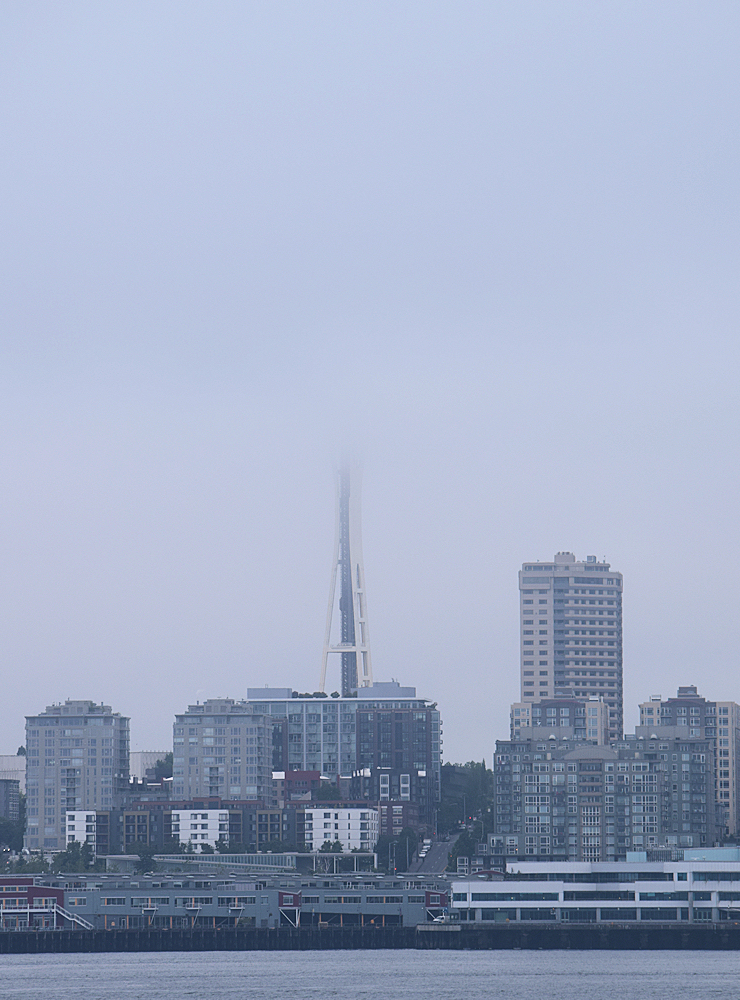
A foggy view of downtown Seattle from the back of the Bremerton - Seattle Ferry

We took the ferry from Seattle to Bremerton to continue our tour and make our way to Olympic National Park. At the end of our trip we returned to Seattle to catch our flight. Instead of taking the ferry, again, we decided to drive over the Tacoma Narrows Bridge which has an interesting history.  


1940, Tacoma Narrows Bridge twisting in the wind
The Tacoma Narrows Bridge is a suspension bridge in Washington that spans the Tacoma Narrows strait of Puget Sound between Tacoma and the Kitsap Peninsula. In 1940, this bridge, referred to as Galloping Gertie, began shaking and twisting violently due to high winds.  It eventually collapsed and was rebuilt.  Before its collapse, the bridge was the third-longest suspension bridge in the world in terms of main span length, behind the Golden Gate Bridge and the George Washington Bridge.  We traveled on this bridge making our way back to Seattle to catch our flight.  


Tacoma Narrows Bridge today

Thursday, March 16, 2017

Angel Fire, New Mexico

Spring break had the two of us itching to get away for a few days. A family member has a cabin at the resort town of Angel Fire, New Mexico, so we took up their offer to stay at their house for a couple of nights.  So, once again, we headed west to the mountains of New Mexico for a little rest and relaxation.
    
View from cabin looking down mountains towards town of Angel Fire

It has been said that Angel Fire is "named for the fiery afternoon light splashed on alpine peaks". The legend behind the name is that the Moache Utes used to gather to renew their ancestral ties with the Great Spirit, and during one of these autumnal celebrations, during the 1780s, three young braves returned to camp from a hunting trip and told of a strange glow at the tip of a peak called Agua Fria. The Utes were a little unsettled as they gazed at this mysterious splash of orange and red flickering in the northern sky. Then the awed silence was broken when one of the elders exclaimed, "it is an omen -the fire of the gods- blessing our annual celebration." Thereafter, whenever that rosy glow was seen it was called "fire of the gods". When Franciscan friars were trying to spread their influence, Agua Fria's "fire of the gods" became known as "the place of the fire of the angels". Kit Carson said that he too had seen the angel fire at dawn and at dusk, especially in the fall and winter months. He said it was because of the sunlight hitting the icy frost on the branches of the trees.

Although we've been to this area many times we had never been during the month of March. We didn't know what to expect in the amount of snow.  As you can see from our pictures it was already shaping up to be a warm spring and there were only patches of snow left on the ground.

During our visit to Angel Fire we drove south of town to the beautiful, spring fed Monte Verde Lake. A large sheet of ice floated in the middle of the lake.  Here we saw a group of Canada geese.

Monte Verde Lake

Canada geese

Apparently, March is the best time for viewing the wildlife - we saw our share. I think the animals, like ourselves, were tired of being cooped up and were ready to be out in the sunshine and enjoying the warm spring air. 

Buffalo nearing Cimarron, New Mexico

Prairie dog in the middle of the town of Angel Fire

Deer spotted from the window of the cabin

Female elk spotted on the road to the cabin

Turkey spotted on the road near the cabin

The northern part of New Mexico is breath-takingly beautiful but some scenes do remind you that this is a harsh place to live.

Abandoned cabin near the ghost town of Elizabethtown, New Mexcio

The remains of an elk - was the hunter human, bear or cougar?

The forgotten Otto Cemetery outside of Clayton, New Mexico